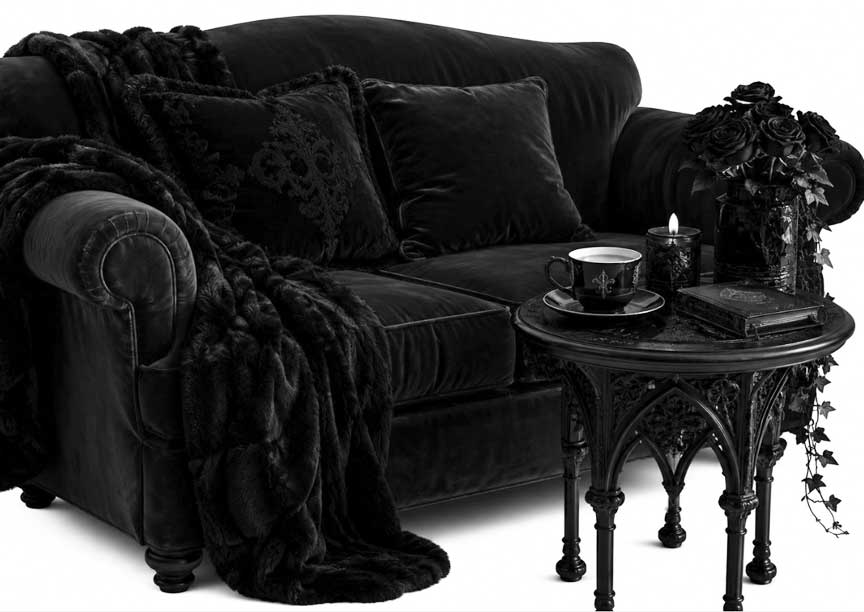
The Sofa Empire
by Tabitha Crow Grimsbane
Chapter 1: The Calm Before the Couch
She lay on the sofa as if it had chosen her, not the other way around. The cushions held her in a slow, inevitable embrace, blankets draped over her like ceremonial robes she had never asked for. Outside, the world behaved sensibly; inside, her body had begun its quiet coup. Progesterone lounged with the smugness of a monarch who had seized power overnight, issuing decrees she had no say in. Mood swings would arrive without warning. Fatigue would flatten her. Nausea would lurk, dramatic and self‑important. None of it waited for her input.
Her immune system hovered like a bureaucrat with a clipboard, muttering its assessments: catastrophic fatigue, persistent brain fog, chaos rising. It didn’t matter that she hadn’t planned any of this. Her body had begun making decisions in private rooms she couldn’t enter, and she felt the consequences ripple through her like weather.
Time loosened. Minutes stretched, folded, dissolved. Naps became acts of survival rather than indulgence, each one a surrender she barely remembered choosing. Ginger tea was summoned like a loyal servant, steaming and fragrant, the only thing she could still command—though even it betrayed her, sloshing over the rim in slow‑motion rebellions. The blankets whispered encouragements she didn’t trust. Somewhere beneath the sofa, rogue socks plotted their own uprising, glaring from the shadows with knitted resentment.
She felt the shift, subtle but undeniable: her body was no longer simply a place she inhabited. It had become a kingdom she’d been drafted to rule, its laws rewritten without her knowledge. Progesterone held court. Fatigue enforced curfews. Brain fog rewrote the map. And she, bewildered and exhausted, found herself crowned in the middle of a hormonal insurrection she hadn’t seen coming.
The Sofa Empire had awakened. She was its queen, whether she wanted the job or not.
Chapter 2: The Day of 12 Naps and One Ginger Tea
Morning arrived without conviction, a faint suggestion rather than a command. She opened her eyes, felt the weight of her own body pressing her deeper into the cushions, and surrendered to the first nap before she had fully woken. Nap #1 dissolved into Nap #2, then #3, each one tipping into the next like a slow chain reaction she no longer had the strength to interrupt. By Nap #7 she had abandoned the idea of resistance. Her body had scheduled its own itinerary, and she was merely being carried through it.
The sofa held her in a slow, steady embrace, neither threatening nor releasing, simply absorbing her as the hours blurred. Every attempt to rise became a negotiation she lost. Fatigue didn’t just settle over her; it issued quiet, immovable orders. Even her thoughts moved sluggishly, drifting in and out like a badly tuned radio. She tried to remember what she had meant to do today, but the idea of “today” felt theoretical, something other people experienced.
Ginger tea became her single act of rebellion. She brewed it with ceremonial care, carrying it back to the sofa as if it were a fragile offering. The steam curled upward like a small, loyal spirit. She sipped it as if it were medicine, armour, strategy. Each swallow was a minor triumph, a reminder that she still possessed at least one deliberate action. The blankets murmured their conspiratorial advice, urging her to stay still, to conserve energy, to accept the day’s absurd trajectory. She didn’t trust them, but she didn’t have the strength to argue.
By Nap #12 she was fully horizontal, drifting in and out of dreams stitched together from the Empire’s strange inhabitants. Rogue socks glared from beneath the sofa, plotting their knitted insurrection. The immune system scribbled invisible notes, offended by her attempts at productivity. Progesterone lounged somewhere above her, pleased with its orchestration of the day’s collapse.
She lay there, suspended between sleep and waking, and felt the quiet truth of it settle through her: she hadn’t lived a day so much as been moved through one. And in that drifting moment, she recognised the helplessness of it, the absurdity of it, and the stubborn flicker of herself still present inside the chaos.
Chapter 3: The Night of Brain Fog and Whispering Blankets
Night didn’t arrive gently. It dropped over her like a heavy curtain, swallowing the room in a thick, oppressive hush. The blankets shifted around her with quiet intent, folding and refolding themselves as though they had plans she wasn’t meant to know. The sofa groaned beneath her, tired of holding her but unwilling to let her go. Progesterone perched nearby with a smug, unbothered calm, already certain it would own the night.
Her thoughts began to slip out of her grasp. Not drift—slip. Edges blurred, sentences broke apart before they reached her mouth, memories flickered and vanished like lights in a failing hallway. She tried to recall whether she had already napped, whether yesterday had unfolded the way she remembered, and why her own name felt faintly out of reach. The questions rose without warning, sharp and disorienting, as if her mind had begun interrogating itself.
The brain fog thickened, not as a haze but as something with weight, something that pressed against her from the inside. It felt deliberate, almost offended by her attempts to think clearly. Time warped. Moments stretched, then snapped. She tried to anchor herself to the room, to the sofa, to the blankets, but everything seemed slightly wrong, slightly shifted, as though the Empire had quietly rearranged its terrain while she wasn’t looking.
She reached for ginger tea, hoping for its familiar warmth, but even that betrayed her. One moment it was in her hand, the next she wasn’t sure where she had put it. The blankets whispered their soft, insistent advice, urging her to stop fighting, to let the fog take whatever it wanted. She didn’t trust them, but resisting felt impossible.
Her immune system hovered like a judgmental spectre, noting every lapse, every confusion, every moment she lost track of herself. Progesterone watched her with lazy satisfaction, pleased with the emotional volatility it had unleashed. Nausea lingered at the edges of the room, waiting for its moment. Even the socks observed her from beneath the sofa, knitted eyes narrowed, as if assessing whether she was still capable of ruling anything at all.
A laugh escaped her, sharp and out of place. Tears followed without warning. The swing hit hard, without logic or mercy. She wasn’t sure whether she was reacting to the fog, the fatigue, or the sheer absurdity of being unable to remember her own day. The Empire pressed in around her, not cruel, not intentional, simply overwhelming in its strangeness.
For the first time, she felt the borders of her own mind shift. The fog wasn’t just confusion; it was intrusion. It reached into her sense of continuity, tugging at the threads that held her together. She lay there, tangled in blankets that whispered too much, surrounded by loyal subjects who had begun to feel like guards, and realised she was no longer simply tired.
The Empire had reached her thoughts. Rationality would not be permitted tonight.
Chapter 4: The Attempt at Standing
She didn’t intend to stand. It wasn’t a decision or a moment of determination. It was the small, instinctive impulse to get up and fetch something she couldn’t quite name. A glass of water, maybe. A charger. Something she thought she needed until she tried to move. She shifted her weight, expecting the familiar sequence of muscles engaging, balance adjusting, the simple mechanics of rising. Instead, nothing happened. Her legs stayed exactly where they were, heavy and unmoved, as though they belonged to someone else entirely. She tried again, more deliberately this time, and felt the unsettling truth pass through her: her body was not responding. Not resisting. Not protesting. Simply failing to comply.
She knew fatigue. She had lived inside it for days. This wasn’t fatigue. This was something quieter and far more unnerving. She tried to coax herself into motion, as if her body were a stubborn animal she could persuade. Just a small shift. Just a lean forward. Just a hand on the sofa arm. But her limbs remained inert, caught in some internal stalemate she hadn’t been invited to. Her mind issued the command; her body ignored it. The blankets tightened around her hips with smug containment. The sofa exhaled beneath her, settling as though relieved she had abandoned the attempt. Even the air felt complicit, thickening around her like a slow tide. She wasn’t pinned. She wasn’t held down. She simply couldn’t rise.
Heat pricked behind her eyes, not from emotion but from the shock of it. Standing wasn’t a grand act. It was the baseline, the assumption, the quiet foundation of every ordinary day. And now it was out of reach. Her immune system muttered its bureaucratic disapproval, noting the failure with officious disdain. Progesterone watched her with idle satisfaction, pleased with the collapse unfolding before it. Nausea shifted in the shadows, preparing its next ambush. The socks under the sofa stared with knitted judgement, unimpressed by her failed ascent. She tried once more, gathering whatever scraps of will she could find, but her body remained still. The refusal was complete.
She sank back, breath unsteady, and felt the truth move through her like an unwelcome current. The Empire wasn’t just inside her thoughts. It wasn’t just steering her days. It had reached her muscles, her movement, her ability to act. She wasn’t simply tired or fogged or overwhelmed. She was being held in place by a kingdom that no longer recognised her authority. And for the first time, she understood what it meant to be confined.
Chapter 5: The Quiet Coup
She stayed still for a long time after the failed attempt at standing, not because she chose to, but because choosing had quietly stopped being part of the arrangement. The Empire had made its position clear. Movement was no longer hers to command. She lay there, wrapped in blankets that had grown far too confident, listening to the faint hum of the room as if it were discussing her in low, administrative tones. Nothing dramatic. Nothing hostile. Just the steady murmur of a system that had begun operating without her input.
The fog from the previous night hadn’t lifted. It had simply changed shape. Instead of blurring her thoughts, it pressed against them, nudging them into strange, unhelpful directions she didn’t entirely recognise. She tried to recall what she had meant to do before she attempted to stand, but the impulse had thinned away, leaving only the memory of failure. Even her intentions were slipping now, breaking apart before she could examine them. It was a quiet erosion, subtle enough to miss until she realised she no longer trusted her own motivations.
Her body felt foreign in a way that unsettled her more than the immobility itself. Not numb, not disconnected—just unfamiliar, as though she were inhabiting a space that had been rearranged without her consent. Her limbs carried a heaviness that didn’t match their actual weight, her joints stiff in ways that didn’t follow any logic she knew. She wasn’t in pain. She didn’t feel conventionally ill. She was simply displaced inside herself, as though her body had been repurposed for something she hadn’t been informed about.
Progesterone observed her with the same idle satisfaction it had shown the night before, not malicious, just smugly present while everything unfolded. The immune system hovered with its bureaucratic disdain, noting every lapse with officious precision. Nausea drifted closer, testing the air like a scout preparing to advance. Even the socks under the sofa seemed to have shifted position, their knitted eyes watching her with a new kind of scrutiny, as though assessing whether she still qualified as their monarch.
She tried to lift her arm. It moved, but sluggishly, as though travelling through thick water. The motion startled her—not because it was slow, but because it felt like the limb belonged to someone else. She watched her hand rise, fingers trembling slightly, and felt a strange detachment drift over her. The Empire hadn’t taken her ability to move entirely. It had taken the ownership of the movement. The action happened, but it didn’t feel like hers. It felt permitted rather than initiated.
She lowered her arm again, slowly, carefully, as though she were handling something fragile. The blankets shifted around her, adjusting themselves with quiet authority. The sofa groaned beneath her, not in protest but in acknowledgement, as though recognising the new terms of her existence. She wasn’t pinned by anything external. She wasn’t being physically restrained. But she was still confined, held in place by a hierarchy she no longer controlled. The distinction didn’t comfort her.
The realisation didn’t arrive all at once. It seeped in gradually, working its way into the spaces the fog had left behind. She wasn’t just overwhelmed. She wasn’t just losing control of her day or her thoughts or her movement. She was being governed. The Empire no longer felt like merely a metaphor or a coping mechanism or a way to make sense of the chaos. It had become the framework through which her body operated, quiet and relentless in its authority. And she was no longer its ruler. She was its subject.
She lay still, breath shallow, and felt the truth lock into place with a cold, steady clarity: the coup had already happened. She had simply been too tired to notice.
Chapter 6: The Evening of Strategic Rest and Dramatic Tea Spills
Evening returned with the slow, velvet weight of something settling into its rightful place. The light dimmed into a muted haze, and the blankets tightened around her hips with officious certainty, as though confirming their jurisdiction for the night. She shifted slightly, ginger tea in hand, aware of the careful choreography required to keep the cup steady. The Empire didn’t need to announce itself; its presence was woven through the room, patient and unhurried, watching her attempt the smallest acts.
Progesterone gleamed from its perch on the armrest, eyes sharp with smug authority.
“You will feel minor panic. Major sighs are guaranteed.”
She exhaled, long and slow. The fog pressed against her thoughts, not smothering so much as rearranging them into slow, looping shapes she couldn’t quite follow. Nausea loitered nearby, bored but attentive. The immune system hovered with its clipboard, noting her attempts with bureaucratic precision. Even the socks under the sofa seemed to shift, their knitted eyes narrowing as she tried to steady the tea.
She attempted a sip. The tea betrayed her instantly, spilling in a thin, dramatic ribbon down the side of the cup. It wasn’t catastrophic, but it was enough to remind her how precarious control had become. She dabbed at the spill with the corner of a blanket, which responded by tightening further, asserting its muted dominance. The sofa beneath her adjusted with the weary resignation of an overworked civil servant processing yet another minor incident.
Journal of Reproductive Chaos — Evening Observation
Subject: Self
Phenomenon: Micro‑movement instability
Hypothesis: Even low‑risk actions (e.g., tea elevation) may be compromised by internal variables beyond conscious command.
Findings: – Grip reliability: inconsistent – Spill likelihood: high – Emotional response: resigned irritation
Conclusion: Control remains theoretical.
She rested her head back against the cushions, letting the room settle around her. The fog thickened, thoughts drifting into slow, unhelpful spirals. She wasn’t frightened. She wasn’t calm. She was simply present inside a body that had begun operating on its own terms. The Empire didn’t need to intervene directly tonight; it only needed to observe, to adjust, to let her navigate the evening with whatever limited agency remained.
She closed her eyes for a moment, feeling the blankets shift with steady authority. The tea cooled in her hand. The socks watched from the shadows. Progesterone lounged with the satisfaction of a minister whose predictions were proving accurate.
She survived the evening one careful sip at a time, documenting what she could, letting the rest pass through her like weather.
Chapter 7: Nightfall and the Great Blanket Conspiracy
Night thickened with a kind of deliberate intent, settling over the room like a slow, heavy curtain. The blankets shifted around her with the restless energy of officials preparing for an internal meeting, folding and refolding themselves into shapes that felt suspiciously strategic. She didn’t move. Movement had become a resource she spent carefully, and tonight the air itself felt dense enough to discourage unnecessary expenditure.
Progesterone lounged nearby, radiating smug volatility.
“Emotions are a tempest. Rage, tears, minor catastrophes — all mandatory tonight.”
The fog had already begun its evening expansion, drifting through her thoughts like a sentient weather system. Nausea hovered at the periphery, not committed to action but present enough to remind her it could intervene at any moment. The immune system flitted about with its clipboard, making notes she would never see, its bureaucratic presence somehow both reassuring and irritating.
The blankets tightened again, this time with unmistakable conspiratorial choreography. One corner folded itself under her thigh; another crept higher along her ribs. She felt like a witness to a quiet mutiny rather than its target. Even the socks under the sofa seemed to shift in the shadows, knitted silhouettes preparing for some minor rebellion she didn’t have the energy to interpret.
She attempted a sip of ginger tea. The cup wobbled, steadied, wobbled again. She managed it, barely, and felt the small victory settle into her chest like a fragile ember. The Empire didn’t celebrate her successes, but it didn’t forbid them either. Tonight, it simply watched.
Her breath caught in a brief, sharp swell — not fear, not calm, but a volatile mix of emotion that felt as though it could tip in any direction without warning. Tears hovered without cause. Laughter threatened without context. Everything felt precarious, as though her internal weather had been set to “unstable” by forces beyond her reach.
She shifted slightly, trying to reclaim a sliver of space from the blankets’ creeping jurisdiction. They responded by tightening again, folding themselves into a shape that felt almost architectural. She wasn’t trapped. She wasn’t restrained. She was simply being… reorganised.
Journal of Reproductive Chaos — Night Observation
Subject: Self
Phenomenon: Blanket‑initiated spatial reallocation
Hypothesis: Nightfall increases autonomous textile behaviour, possibly correlated with emotional volatility.
Findings: – Blanket movement: coordinated – Sock activity: elevated – Emotional stability: compromised
Conclusion: Environmental factors appear complicit.
She let her head fall back against the sofa, feeling its weary bureaucracy shift beneath her. The fog thickened further, thoughts dissolving into soft, indistinct shapes. The blankets tightened once more, completing whatever quiet conspiracy they had begun. She didn’t resist. She didn’t surrender. She simply existed inside the slow, deliberate reorganisation of her surroundings, ginger tea cooling in her hand, socks rustling in the shadows.
The Empire adjusted the space around her, and she endured it — one careful breath at a time.
Chapter 8: The Dawn After Chaos
Morning didn’t so much arrive as seep in, a pale, tentative presence that gathered slowly at the edges of the room. It felt hesitant, as though testing whether the space was safe to inhabit after whatever the blankets had orchestrated overnight. The air carried a faint sense of rearrangement—not clarity, not relief, but the subtle shift of a room that had been quietly re‑ordered while she slept. She blinked, slow and deliberate, letting her awareness settle before attempting anything more ambitious. The blankets lay in careful folds around her, arranged with the eerie precision of officials who had completed their nocturnal reorganisation. She shifted, cautiously, and found that movement came with slightly less resistance than she expected. Not ease—just possibility.
She sat up a fraction. The sofa adjusted beneath her with its usual bureaucratic sigh, but even that felt altered, as though it had processed a new set of internal forms during the night. Socks peeked out from under the cushions, their knitted expressions unreadable but distinctly alert. Nausea lingered at the edges, unimpressed but not immediately hostile. She reached for her ginger tea. The cup was still where she’d left it, cooled but intact. She lifted it with careful precision, expecting the wobble, the betrayal, the spill. None came. The sip was small, but it was hers.
Progesterone lounged on the armrest, watching her with the smug detachment of someone who had anticipated the chaos but refused to claim involvement. “Small victories are monumental,” it murmured—not kindly, not cruelly, simply stating a fact. She breathed out. The fog still hovered, but thinner now, as though the night’s reorganisation had pushed some of it aside. She could think, not clearly, but enough to recognise that something about the Empire had shifted again. Whether it was the room itself or simply the way she was experiencing it, she couldn’t tell.
The blankets rustled, offering what might have been encouragement or warning. The socks glared with knitted suspicion. The immune system hovered with its clipboard, making notes she would never see. She took another sip of tea, steady this time. The moment didn’t settle into her chest like truth or triumph; it simply existed, a small functional fact in a morning that felt marginally less hostile.
She lowered the cup, feeling the room settle around her in its new configuration. The Empire wasn’t calmer—just quieter, as though its overnight adjustments had created a temporary pocket of stability she could move within. She didn’t rush. She didn’t test it. She simply existed inside the aftermath, ginger tea warming her hands, the blankets resting in their new formation, the socks watching from the shadows. For the first time in days, she felt the faint outline of a morning she might survive.
Chapter 9: The Day of Conditional Functionality
By midday the room had settled into a strange, provisional calm, the kind that felt borrowed rather than earned. She moved slowly, testing the edges of her regained functionality with the caution of someone handling fragile glass. The blankets lay in their folded formations, not dormant but watchful, as though monitoring her attempts to navigate the day. Even the air felt different—less dense, less resistant, but still carrying the faint hum of an Empire that had not relinquished control so much as paused its interference. She stood carefully, letting her weight shift from the sofa to her feet. The floor met her with a muted thud, steady enough to reassure her but not steady enough to trust. Socks peered from beneath the coffee table, their knitted expressions narrowed in suspicion, as though evaluating whether her verticality was authorised. She ignored them. Today she needed to test what the morning had offered.
She crossed the room in slow, deliberate steps. Each movement felt like a negotiation: her muscles offering effort, the Empire’s influence shaping how far that effort travelled. The fog hovered at a polite distance, not gone but less intrusive, as though observing her with mild curiosity. Nausea drifted in and out of her periphery, uninterested for now. The immune system followed her with its clipboard, briskly recording each attempt as though her temporary functionality required formal verification. She reached the kitchen counter and rested her hand on its cool surface. The stability felt almost generous. She lifted her ginger tea from where she’d left it earlier, the cup steady in her grip. The sip was smoother than the morning’s—still small, still cautious, but undeniably hers. For a moment she allowed herself the dangerous thought that perhaps the Empire’s pressure had eased.
Progesterone appeared at the doorway, leaning against the frame with theatrical indifference. “Do not mistake temporary coherence for progress,” it said, voice flat, eyes gleaming with smug volatility. “The afternoon is unpredictable.” She didn’t respond. She didn’t need to. The Empire rarely offered warnings without reason. She set the cup down and felt the faint tremor in her fingers, not fear, not weakness—just the reminder that her stability was conditional. The blankets rustled from the living room, shifting in a way that suggested they were preparing for something. Not a coup. Not a mutiny. Just a recalibration.
She picked the cup back up and returned to the sofa, moving with the same careful deliberation she’d used to leave it. The cushions adjusted beneath her, their bureaucratic sigh familiar and oddly comforting. The socks retreated into the shadows, their surveillance temporarily suspended. The fog drifted closer again, not oppressive but present, as though reclaiming its usual territory. She sat with her ginger tea cooling beside her, aware that this brief window of functionality existed without promise or permanence. The day wasn’t hostile. It wasn’t kind. It was simply conditional—an arrangement she could inhabit for now, knowing it might shift at any moment.
For a while, she existed inside that fragile balance, moving when she could, resting when she needed, and letting the Empire’s quiet recalibrations unfold around her like weather she could neither predict nor prevent.
Chapter 10: The Afternoon of Inconsistent Logic
The afternoon settled over the room with a strange, uneven temperament, as though the Empire had begun operating on a set of internal rules that shifted every few minutes. She felt it first in the air, which couldn’t decide whether to be warm or cool, brushing against her skin with alternating intentions. The blankets lay in their folded formations, not entirely still but not actively reorganising either, holding themselves in a posture that suggested they were waiting for something. She rose from the sofa with the same cautious optimism she’d carried through the morning, expecting the conditional stability she’d managed earlier. Instead, her legs wavered in a way that didn’t feel like weakness so much as the room subtly misaligning itself around her. The floor met her feet at an angle she hadn’t anticipated, not enough to alarm her but enough to make her pause and question whether she had misjudged her own balance.
She took a few steps, slow and deliberate, letting her body negotiate with the afternoon’s shifting logic. Each movement landed differently: one step felt steady, the next felt as though the ground had risen a fraction to meet her, though she knew it hadn’t. The fog drifted in and out of her awareness, not thickening but flickering, its presence inconsistent, appearing and dissolving like a faulty signal. Nausea hovered with renewed curiosity, not committed to action but clearly paying attention. The immune system followed her with its clipboard, making brisk notes as though documenting the room’s behaviour rather than hers. She reached the kitchen counter and rested her hand on its cool surface, grateful for the solidity even as she noticed it felt slightly further away than she remembered. The ginger tea she’d left there sat at a faint angle she couldn’t explain. She lifted the cup, expecting the steadiness she’d managed earlier, but the cup shifted in her hand by a fraction—just enough to make her tighten her grip. It wasn’t graceful, but it worked.
Progesterone lingered near the doorway, watching her with an expression that suggested it had seen this kind of instability before. “The Empire’s conditions fluctuate,” it said, voice flat and unhurried. “They don’t hold still for long.” It didn’t elaborate. It never did. She didn’t ask. She simply breathed through the unevenness, letting her body adjust to the unpredictable rhythm the room had adopted. The blankets rustled from the living room, shifting their folds with quiet purpose. The socks under the table repositioned themselves, their knitted eyes following her with renewed suspicion, as though evaluating whether she was keeping up with the room’s changes.
She made her way back to the sofa, not retracing her earlier movements but finding a new path through the room’s subtle inconsistencies. The cushions adjusted beneath her with a sigh that sounded less bureaucratic and more weary, as though even they were struggling to keep pace with the Empire’s shifting logic. She rested her hands on her lap, feeling the faint tremor of effort in her muscles—not frailty, but the strain of adapting to conditions that refused to remain consistent.
The afternoon didn’t settle into any clear temperament. It didn’t offer clarity or collapse into chaos. It simply continued, uneven and unpredictable, and she existed inside that refusal, adjusting moment by moment, breath by breath, until the room settled again—or until she did. And she couldn’t tell whether she was learning to navigate the instability, or simply becoming accustomed to doubting what she felt.
Chapter 11: The Rhythm Beneath the Instability
By evening the room carried a strange pulse she couldn’t quite locate, a slow, uneven rhythm that seemed to move through the space without settling anywhere. It wasn’t steadier than the afternoon, but it felt different—less like chaos and more like something shifting beneath the surface. She sat for a moment, letting the cushions adjust beneath her, and realised she could feel the fluctuations gathering before they reached her. It wasn’t anticipation; it was simply the faint pressure that preceded each shift, a sense of movement forming rather than any ability to predict when or how it would arrive.
She didn’t stand this time. Instead she leaned forward, elbows on her knees, and let her attention drift across the room. The air moved in faint waves, brushing past her with alternating resistance, as though the atmosphere itself were breathing unevenly. The fog rolled in again, not flickering now but gathering in a slow swell that rose and thinned in a pattern she couldn’t map but could feel. Even the light seemed to shift in small, irregular pulses, brightening and dulling by degrees she wouldn’t have noticed earlier. She wasn’t sure whether the room was changing or whether she was finally noticing the way it always moved.
She reached for the blanket beside her, not to use it but to test the rhythm against something tangible. The fabric felt steady under her hand, but the steadiness carried a faint tension, as though it were bracing itself against the room’s uneven pulse—or perhaps she was only more aware of its weight. The socks near the coffee table didn’t reposition themselves; they simply seemed to watch her with a kind of alert stillness, their knitted expressions unreadable. She couldn’t tell whether they were responding to the rhythm or whether she was projecting her own unease onto them.
Progesterone lingered near the bookshelf, not in the doorway, its posture loose, its attention fixed on her rather than the room. “You’re starting to notice the timing,” it said, voice low, almost conversational. “Not what it means. Just how it moves.” It didn’t sound impressed or concerned—just matter-of-fact, as though this stage was inevitable. She didn’t answer. She wasn’t sure she could articulate what she felt without making it sound more certain than it was.
She shifted her weight, letting her body respond to the room’s uneven cadence. The fluctuations didn’t stop, but they arrived with a kind of delayed predictability, each one following the last by a rhythm she could sense even if she couldn’t foresee its next turn. She wasn’t navigating it. She wasn’t mastering it. She was simply beginning to recognise the shape of its movement, the way the instability curved through the space like a tide that refused to settle.
She let her hands rest loosely in her lap and breathed with the room’s uneven pulse. It didn’t soothe her. It didn’t unsettle her. It simply moved, and she moved with it, unsure whether she was discovering a rhythm in the Empire’s fluctuations or whether her mind was creating one to survive the day. And as she sat inside that uneven pulse, she realised she couldn’t yet tell whether the rhythm was emerging from the room or from the quiet, desperate need to make sense of it.
Chapter 12: Total Hormonal Insurrection
Night settled around her with the same uneven rhythm she had spent the evening trying to understand, but something new had joined it now, threading itself through the fatigue with such stubborn insistence that she could no longer pretend not to notice. The blankets remained folded around her legs with officious precision, the socks watched from beneath the coffee table, and ginger tea rested within reach. Progesterone sat on the armrest wearing a ridiculous crown of tissues, looking far too pleased with itself for something that had contributed absolutely nothing useful to the running of the Empire.
The immune system hovered nearby with its clipboard, muttering its usual assessment. Fatigue remained catastrophic. Brain fog remained oppressive. Nausea was present and apparently considering its options. Movement was still conditional. None of this was new. What was new was the unmistakable surge of desire running beneath all of it, bright and completely incompatible with the rest of her body’s current operating conditions. She sat very still, waiting for the sensation to reconsider. It did not.
Her body was exhausted. Her thoughts were unreliable. Standing had become something she approached with planning rather than assumption. She had spent several days treating the successful transportation of ginger tea as a measurable achievement. Apparently her reproductive system had received none of these reports. It had arrived with enthusiasm, urgency and absolutely no concern for available resources. The absurdity of it caught her before irritation could. A laugh escaped, sharp and incredulous, and Progesterone’s expression shifted into the smug calm of an official whose department had been expecting this development all along. She reached for the Journal with the solemn determination of someone faced with evidence too ridiculous to remain undocumented.
Journal of Reproductive Chaos
Nuclear Horniness and Other Poorly Timed Biological Events
Subject: Self
Phenomenon: Acute reproductive enthusiasm during severe physical depletion
Hypothesis: Catastrophic fatigue, brain fog, nausea and unreliable mobility should reasonably reduce interest in additional physical activity.
Findings: – Fatigue: catastrophic – Cognitive clarity: compromised – Physical functionality: conditional – Reproductive interest: offensively high – Timing: indefensible
Conclusion: Hypothesis rejected. Interdepartmental communication remains nonexistent.
She read the conclusion once, then again, because it deserved verification. The Empire had spent days refusing coherence, but this felt like a particularly impressive administrative failure. Fatigue demanded stillness while desire demanded the exact opposite. Brain fog could barely keep hold of an ordinary thought, yet her body had apparently located this one with astonishing precision. Nausea hovered nearby, unconcerned by the contradiction. The blankets tightened fractionally around her legs, making the situation feel less like temptation and more like a scheduling error of national importance.
Progesterone adjusted its tissue crown and observed her with maddening calm. “Hormonal diplomacy has failed.” She looked at it, too tired to dignify the statement with more than a raised eyebrow. “That suggests there were negotiations.” Progesterone offered nothing further, which somehow felt like confirmation.
She lifted the ginger tea and took a careful sip, still aware of the ridiculous current beneath the exhaustion. Nothing had resolved. She was still tired, still fogged, still operating within the strange conditional logic of the Empire, and now apparently horny enough to require formal documentation. The contradiction refused to become sensible simply because she had named it, but naming it gave the absurdity edges she could hold.
The Journal rested beside her, its newest entry sitting among the evidence of everything her body had done without consultation. The blankets maintained their jurisdiction. The socks remained suspicious. Progesterone continued to wear its crown. Somewhere inside the Empire, one department carried on with spectacular confidence while the rest of the system struggled to remain operational. For tonight, that was the finding.
Chapter 13: The Grand Finale of the Sofa Empire
Night reached its peak with all the restraint of a collapsing government. The uneven pulse she had spent hours trying to understand no longer moved quietly beneath the room; it seemed to arrive from several directions at once, rising through the sofa, pressing through the air, gathering beneath her skin until every part of the Empire appeared to be operating according to its own private emergency. The blankets had abandoned any remaining pretence of cooperation, winding themselves around her legs and bunching beneath her hips in folds that made every attempt to shift position unnecessarily complicated. Socks had appeared in places she was certain had been empty moments earlier, their knitted rebellion apparently advancing beyond surveillance into active occupation. Progesterone remained on the armrest, tissue crown slightly crooked but still firmly in place, watching the disorder with the maddening composure of someone who had expected nothing better from the evening.
The immune system hovered nearby with its clipboard, surveying conditions with grim bureaucratic efficiency. “Fatigue: total. Brain fog: oppressive. Nausea: minor deity. Chaos: absolute.” She would have objected if any part of the assessment had been inaccurate, but her thoughts were already tangling again, slipping into one another before she could finish them, while nausea drifted closer with renewed interest. Her muscles felt heavy, her skin strangely alert, and the reproductive enthusiasm documented earlier had apparently decided that catastrophic exhaustion was no reason to reconsider its priorities. She was tired enough to disappear into the cushions, foggy enough to mistrust ordinary objects, nauseous enough to resent the existence of food and still, somehow, offensively horny. Apparently the Empire had reached the stage where contradiction was no longer a malfunction but official policy.
A laugh escaped before she could stop it, sharp and breathless, followed almost immediately by tears that arrived without explanation and irritated her enough to make her laugh harder. The emotions piled into one another without waiting their turn, rage nudging against amusement, exhaustion pressing beneath both, until she could no longer tell which one had started the whole thing. Progesterone adjusted its crown with infuriating precision while the immune system scribbled faster, presumably delighted to have fresh data. The blankets tightened when she tried to move, one sock pressed beneath her heel with such perfectly terrible timing that she nearly accused it of treason, and somewhere inside the fog a perfectly ordinary thought attempted to form before vanishing again. She sat in the middle of it all, crying, laughing and increasingly convinced that whoever designed the human body had abandoned the project halfway through and refused to answer subsequent emails.
She reached for the ginger tea because apparently some instincts survived every collapse. Her fingers closed around the cup and held steady for one promising second before the blanket trapped beneath her elbow shifted, her arm jerked and tea tipped over the rim in a warm, dramatic sheet. It splashed across her fingers, disappeared into the folds around her lap and left a dark stain spreading through the fabric with the solemn inevitability of a national disaster. She froze. The blankets seemed to freeze with her. Even the immune system paused its writing. Then the sheer stupidity of it broke whatever remained of her composure, and she laughed until her stomach hurt, tried to rescue the cup, spilled slightly more, swore at the blanket and immediately regretted the effort when nausea surged forward in response.
Everything wanted something different from her. Fatigue wanted her still while desire remained entirely uninterested in the arrangement. Nausea objected to food while another part of her body insisted food might help. Brain fog wanted thought abandoned entirely, yet the immune system continued documenting every failure with bureaucratic enthusiasm. The blankets wanted territory, the socks wanted revolution, Progesterone apparently wanted a throne, and she wanted five uninterrupted minutes in which no internal department issued a fresh decree. “I am absurd,” she said through the remains of her laughter, watching Progesterone as though daring it to disagree. “I am exhausted, enraged, unhinged and apparently still fucking horny.” Progesterone merely lifted its chin beneath the tissue crown, which somehow felt like confirmation.
She sank back into the cushions with the surviving tea still in her hand, tears drying on her face and a sock lodged beneath her heel. Nothing had resolved. The fog remained, nausea continued hovering, fatigue dragged at every limb and the blankets showed no intention of surrendering their territory. The rhythm beneath the instability was still there too, buried somewhere beneath the competing demands, impossible to follow now that the entire Empire had descended into open administrative chaos. She could not control it, predict it or make its contradictions sensible, but she could still laugh when it became ridiculous, swear when it became unbearable and survive whatever minute happened to come next.
The room continued around her, dramatic and unruly, full of whispered conspiracies, hormonal declarations, cooling ginger tea and knitted insurgents. Somewhere beneath it all her body carried on doing what it had done from the beginning, making decisions in rooms she could not enter and presenting her with the consequences afterward. She rested her head against the sofa and let out one last exhausted laugh as Progesterone’s tissue crown slipped slightly sideways. The Sofa Empire had not been conquered, cured, understood or persuaded to behave. It remained chaotic, contradictory and completely incapable of ending politely. Somehow, so did she.
BIO

Tabitha Crow Grimsbane is a UK-based author of psychological horror, dark fantasy and speculative fiction. Her work explores pain, identity, bodily autonomy, consequence and the strange systems people build to survive.