Los Alamos: Complicit
by Julie Piehler
I leaned over the battered, hip-high table and gasped. In a blink my mind oriented itself to the perspective and scale of the photographic collage unrolled before me. It was comprised of tens of high-resolution aerial photographs meticulously Scotch taped together. None of the photographs quite matched at the margins, as each was taken from a slightly different position by the low-flying reconnaissance mission. None of the dozen others standing on all sides of the table with me made a sound, above that of carefully regulated breathing. I bit back the exclamation I was about to make and became still as a fawn camouflaged on a forest floor. I peeked covertly right and left. Everyone stood silently looking straight forward at the collage, expressionless as soldiers at attention. None leaned in to get a closer look. All were careful not to catch the eye of another. They each already knew.
It was the mid-eighties, still on the cusp of the Cold War, and in a different era for information access. High resolution aerial photographs and satellite images were tightly regulated. There was an urban legend that satellite images had become so good that license plates could be read from orbit. But these images weren’t accessible to just anyone with an internet connection, as they are today. Even the low-resolution images available to the public had enormous tracts that were whited out, almost screaming, “Look here! Look here!” And before us figuratively unveiled on the table was one of those whited-out spaces, depicted in razor-sharp detail.
Back then, I could have been jailed for letting two words cross my lips in public: Yucca Mountain. This complex of arid hills and peaks was the region in the Nevada desert chosen to be the national repository for spent nuclear fuel, waste from civilian nuclear power plants that was so concentrated in uranium, plutonium and other toxic heavy metals that it could be used just as it was to make dirty bombs. With patient use of fairly old technology, it could even be enriched to make nuclear bombs.
There was a beehive of studies ongoing at Los Alamos, where I was a summer intern. The objective was to prove that the Yucca Mountain site was viable and would remain so for a hundred thousand years—the time it would take for the spent fuel to decay to the point that, when its containment was breached, it would not be a tragedy for humankind.
But read me closely here. The objective was not to determine if the site was safe; it was to determine that the site was safe. There were no other candidate sites. No other state would accept this waste. And commissioning a permanent repository was urgent: all the high-level waste in America was still held where it had been used, in temporary storage at the fifty-odd civilian nuclear power plants dispersed around the country. These plants were designed with the assumption that there would be a central national repository for their spent fuel. So, as the clock ticked on, year after year with no permanent repository, each plant had to cobble together more and more temporary storage—basically strings of circulating swimming pools in which the spent fuel rods were kept cool.
Think of one hundred thousand years relative to the evolution of human culture. The roots of writing are less than ten thousand years old. We had to assume that no current human language nor form of writing could be comprehensible to the distant descendants that might stumble across the forgotten repository. So how should we now create signage to warn these descendants away from the site?
There were so many questions to answer. What if the climate changed and this now-arid site became sodden, and the hot metal waste canisters began corroding ten times faster, a hundred times faster? Should the waste be formed into glass pellets so it would be less soluble, but thus unclench new risks by bringing it to molten temperatures? How could the waste be protected from terrorists during transport from the power plants to the repository? How could it even be transported at all, given that no state but Nevada would allow the waste on its highways?
But on the table before me, I saw the end of all the questions. Circles. Tens of sharply defined circles, in clusters and strings, decorated the collage from under the figurative white veil of secrecy. A sophomore geology major would be able to identify those circles as the rims of explosive volcanoes—think the blast of Mount St. Helens or Krakatoa, not the relatively placid oozing of Hawaii’s non-explosive volcanoes.
These volcanoes could blast mountains into fine powder sending it miles into the atmosphere where it would circulate the globe for years, until gently falling, more silently than snow. The pulverized grit of toxic waste would settle onto the upturned faces and deep into the lungs of our descendants. The sharpness of the delineations of the volcanoes in the aerial images meant they were recent. Cycles of wind and rain, of freezing and thawing, had barely begun to erode them since they last exploded. In a geologic sense, this volcano field was still active. A new explosive eruption could occur at any time or location in the volcano complex. Burying the waste at Yucca Mountain would be like making a terrorist’s dirty bomb, while leaving the fuse of indeterminate length.
Nowadays, in the 2020s, anyone can conjure from the ether a high-resolution map of Yucca Mountain, exposing the circular volcanoes that had so horrified me. Meanwhile, four decades more worth of spent nuclear fuel is in temporary storage at the power plants where it was used. Anyone can read about the vicissitudes of a chain of Nevada governors weighing the boon of job creation if the Yucca Mountain repository is realized against the backlash of the informed electorate. Back then, the ultra-secret geologic maps dated the volcanoes as less than ten thousand years old. Now, some argue they may be as much as eighty thousand years old, and besides, they only cover ten percent of the site. Is this quibbling the fruit of forty years’ labor of my long-ago colleagues?
Laugh or weep? Most of North America resides on bedrock that is extremely stable. Swathes thousands of miles long and wide have not seen volcanism for billions of years. And yet we seek to bury our most toxic waste in an active, explosive field of recent volcanoes.
Everyone around the table knew. They must have whispered each to each. But no Los Alamos scientist said a word aloud in public. I, the youngest, newest, and least astute of the complicit band, I too, was silent. After the meeting, each turned away from the map of circles. We each returned to work on one of the thousand questions to which the answer was already given—Yucca Mountain was somehow a safe and stable location, a reasonable choice for storing our most toxic creations for the next hundred thousand years.
BIO
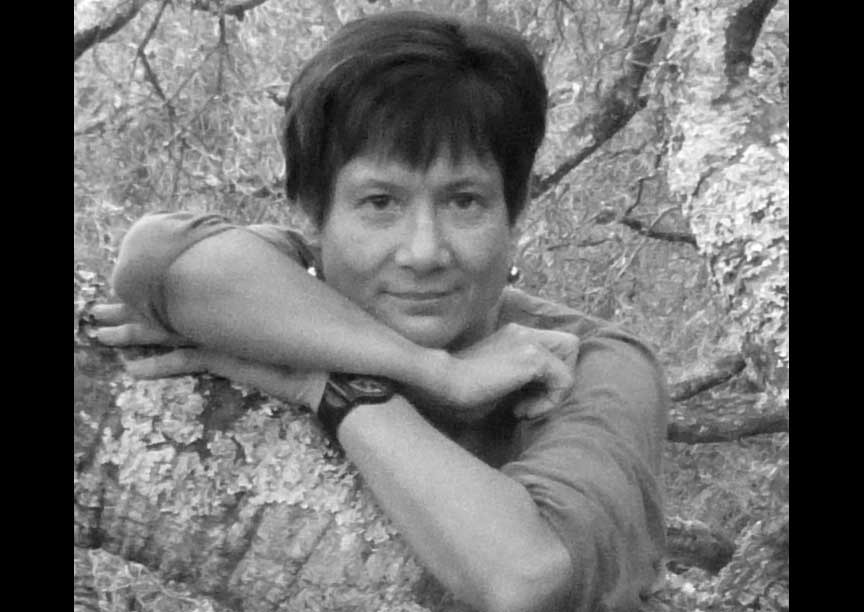
Julia Piehler has published in technical journals and compendia during a high-tech career. Her work spanned many job functions. Throughout her career she has collected bouquets of stories and poems that will appeal to the general reader. She was educated at Harvard and Stanford where she specialized in geochemistry.