
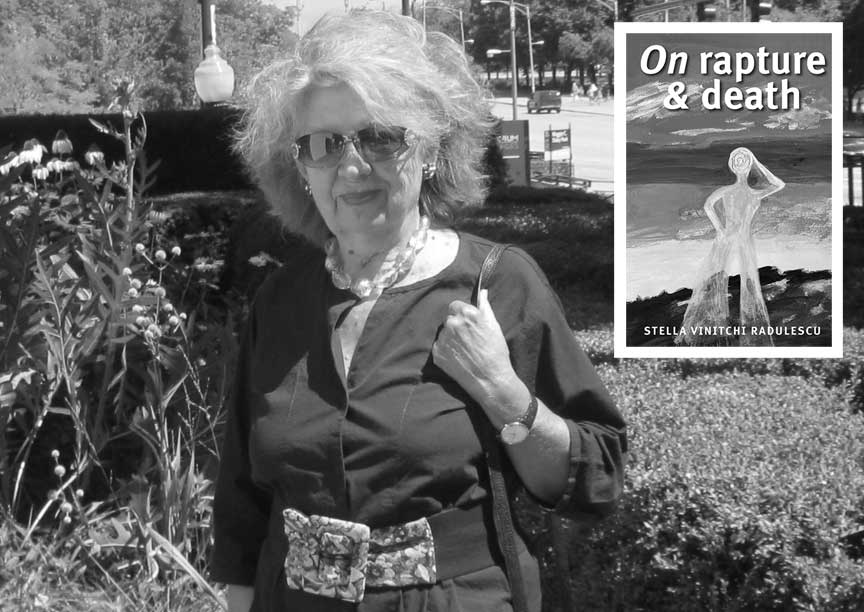
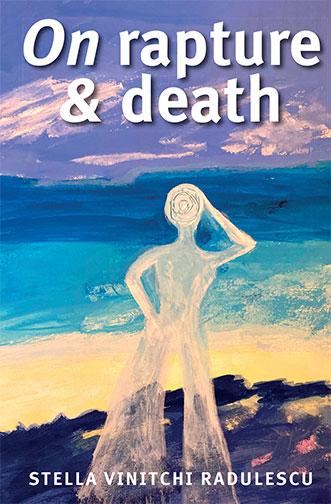
On Rapture And Death
by Stella Vinitchi Radulescu
Published by Solis Press, England, 2025
Review by Danijela Trajković
Stella Vinitchi Radulescu is a prolific poet. She is the author of several books, and writes in her mother tongue Romanian, as well as English and French. She comes from Europe and lives in the USA — two continents, two homes. In her poetry she drugs the roots from Europe, planting them in the USA, adapting the ‘plant that survives and gives fruits’. That’s what Stella offers to her readers: hope that we can always start a new life without getting rid of our origin, our past or even our traumas. And this is what a poet does: creating a new world, more beautiful, where we can be honest with ourselves, and with other people; offering the opportunity to dream, find the lost inner side of us, enjoy and cry while reading this book, learning again and again about who we are indeed.
As a writer of literary criticisms and reviews, I have noticed that Stella’s poetry follows the modern way of writing, using free verse, but mostly the author follows herself; the unique look of the verses is the most striking thing that the reader first encounters when reading Stella’s poetry. That is what symbolizes her poetry, and what sets her apart from the crowd of her contemporaries. The verses do not follow a particular style of writing, but the style of the author, which, it seems to me, is unique and completely different from the appearance of the verses of other contemporary poets: punctuation marks, and — always used instead of and; using only small letters with some exceptions. One verse, for example, goes so that there is a gap between the words or after the gap follows a punctuation mark, which is really something extraordinary:
‘teeth sharpening angels—’
‘East undoing roads
and rivers what’s lost
came back again’
Perhaps the poet puts us in that gap, somewhere halfway, to stop and think about what we have read. It is also possible that the poet is preparing us for the impressive continuation of the poem. The book has four chapters. Every next chapter has more poems than the previous one. Intentionally? Not? A coincidence? I don’t believe in coincidences. Stella is a meticulous poet. Her poetry is equal to strategic warfare. The beauty of Stella’s poetry is exactly in these things: carefully chosen words, keeping attention of a reader, making a reader to stop reading and think, to go back and read previous verses again due to enjoy or understand them better, to relive what has already read. Stella’s poetry is difficult. Not everyone can understand or analyze it. Her poetry should be read rather by other poets, or ordinary people who have read many books, books of poetry, lovers of poetry, smart, able to penetrate into what she tells us with her poems, and get the messages she sends through her poetry. Stella is definitely one of the most significant literary figures and greatest poets of the 21st century.
In On Rapture And Death readers can find them on a new, different journey full of colours, love, flowers, nature, nostalgia, homesickness, solitude, empathy, searching and finding oneself; the past, the present and the inevitable future waiting for all of us. The author uses personification wonderfully.
‘I am blind I need a flower
to take me
to my house’
The poet feels lost in the world. It’s an eternal human’s need to belong somewhere. She feels like a being in another woman’s body. Looking at the sky, she finds that her body is actually hers. She tries to tell us that the sky helps us to rediscover ourselves, makes us feeling alive, full of hope, self-confident, and gives us again once forgotten joy that life brings within: no depressive thoughts, an immediate return of happiness. The sky is the mirror claims the poet, and only in us we can find our peace and happiness. In silence and nature one can feel that his/her home is the Earth, tells us the poet.
‘my face is pale green
like Spring in the valley’
An amazing comparison with the nature! The poet is tired as well, and has nothing else to dream about since she has seen everything. It’s the moment of tiredness, depression, fear what else is left to do in life. Every reader can recognize him/herself in the verses of Stella’s. All of us have experienced such feelings. The author of On Rapture And Death watches the nature, finds motifs in it, compares herself, and doing that she makes readers do the same, which finally brings to the conclusion that WE are the nature, and THE NATURE is us.
The poet uses word eyes a lot, meaning the awareness of the fact that we are all watched by others, and we watch them, too. A symbol of the view through others and our souls, the view of human nature. In On Rapture And Death Stella shares her longing for old, good times when people were more people, had respect for their relatives, neighbours, friends; for the value of family homes, towns built with human hands and love, made not only of bricks but dreams, as well. The new era brings the opposite of all that used to be: sadness. The poet in two verses achieves to ‘paint the painting of thousands details’.
‘old houses & old towns are losing
their meaning’
Losing meaning brings with it losing faith in the present, the future, and nostalgia for the life we lived once. Stella mentions one very important and alarming truth. The next generations maybe will never see the houses of their ancestors. That is what troubles the poet, and that is what should trouble world population. No history, changed history, hidden history is the enemy that approaches slowly but surely.
‘we are in the era of guns
loaded with flowers
and blood’
The poet in this book is occupied with many thoughts – thoughts about her own being, thoughts about other people’s destinies, questions about how to continue, warning and craving for our awakening; the pleasure of spending time in/with nature, finding joy in plants and animals, wind, rivers, ponds, meadows, seasons … It’s the book that simply speaks about rapture and death as inevitable parts of our temporary stay in this world – we are just temporary tenants and nothing else. Knowing what we are, what to expect, in her poetic voice the poet says the lullabies so relaxing to her readers who can nothing but the seriousness of life watch through one more beautiful pair of eyes. The book offers its most honest and intimate point of view on life and death, the unselfishness to share with us great and pure things, poor and miserable things, joy and fear, a down to earth minds and non-responsible ones, the game of life, the rapture and the death.
‘…what do you do with
your hands when nobody
asks you to light a candle—
inside the house’
Missing her parents, especially father, the first home she had, the first land she stepped on. Suddenly, everything is green like her homeland which expresses her homesickness. Through various colours the poet finds meanings. And, there are colours that appear many times: red and blue. Very intriguing for a reader. Loneliness, craving for company, feeling the death’s approaching:
‘I measure in yellow steps
the distance to my grave’
Dust to dust, ashes to ashes! The poet reminds us on this sentence by using the word ash as the last word of the book. But before, she tells us something awesome, like telling us a secret of life with all her generosity, she grants us knowledge:
‘…green night & foggy tongue
to name a thing it takes
a life…’
BIO

Danijela Trajković (1980) is a Serbian poet, reviewer, translator, short story writer, essayist and the editor-in-chief of ‘ A Too Powerful Word’ magazine. She is the author of two books: ‘ 22 Wagons’, Istok, Knjaževac, 2018 and ‘ While Life Sees a Dream’, Arte, Belgrade, 2023. She holds an MA in English language and literature from the University of Prishtina, Faculty of Philosophy in Kosovska Mitrovica. Her works have been translated into more than twenty languages and published worldwide in newspapers, magazines and anthologies.


 is a Serbian poet, reviewer, translator, short story writer, essayist and the editor-in-chief of ' A Too Powerful Word' magazine.)