Crush by Ada Calhoun: A Libertine’s Reward
Review by Hugh Blanton
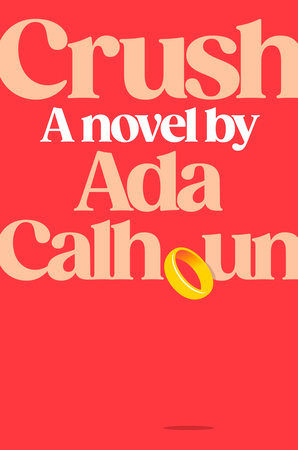
Crush
by Ada Calhoun, 273 pages
Viking, $30.00
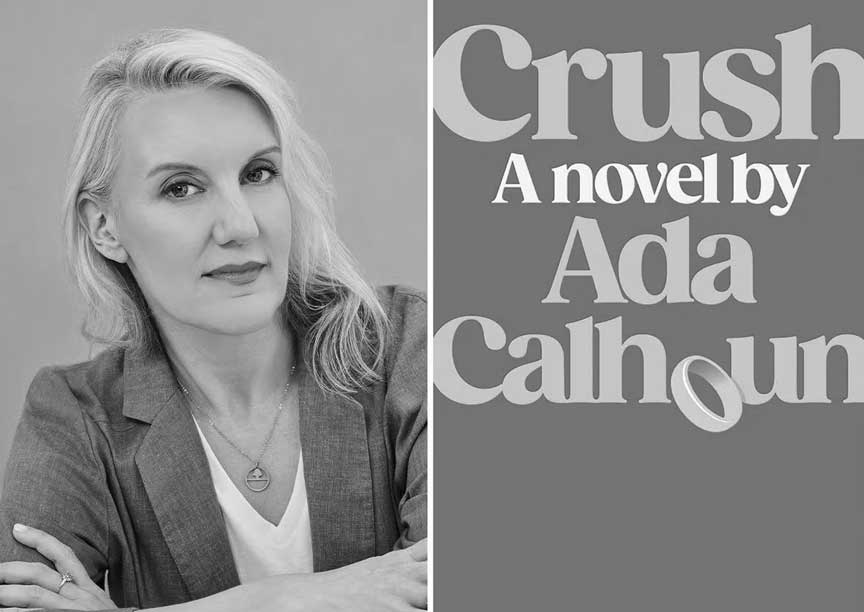
A lot of reviewers of Ada Calhoun’s Crush say that the book reads more like a memoir than a novel, both in content and tone. Ron Charles, writing for The Washington Post, went so far as to say that Crush is like an audiobook on paper. In fact, Calhoun said that she had indeed started to write it as a memoir, but that it “made no sense.” She’s quick to add, however, that none of the people in Crush have a real-life corollary, not even the book’s narrator who very closely resembles Calhoun. It would be very easy to imagine Calhoun’s closest friends slamming the book to the floor after reading it and recognizing themselves—maybe even running to the nearest courthouse, lawsuit in hand. (Unless of course they had second thoughts about letting the public know what schmucks they are.)
Our unnamed narrator’s husband, Paul, is an immature artist who refuses to sacrifice his art for the ignominy of a day job, so she supports him and pays the bills. She appears to be mostly okay with their arrangement, although it sometimes leaves her “in a state of endless work and occasional panic.” She’s been raised traditionally; she finds meaning in caretaking, marriage, raising a family. One morning, seemingly out of the blue, Paul suggests to her that he’d be okay with her kissing other men. She of course rejects the notion—at first. And then of course after thinking it over begins to believe it’s a great idea. Now, there’s no need for a spoiler alert here. This blows up like nearly all “open marriages” do. Cuckolds, even voluntary cuckolds like Paul, can’t stand the thought of their wives out somewhere being intimate with other men. It’s emasculating regardless of how consensual it may have been, especially for our husband here who lives off of his wife’s earnings. (She does the housework and cooking too, Paul is scarcely more than a bum.)
If you enter keyword search term “open marriage” into Google, the first several results are web pages and YouTube videos with “Didn’t Work Out” or “Didn’t Go Well” or “Backfired” in the titles. (One Reddit thread is titled “Open marriage? sure, biggest mistake of my fucking life!”) Why would people enter into open marriages knowing how catastrophic the outcome will likely be? Whether they are seeking some sort of emotional/sexual fulfillment or are just plain promiscuous, any reasonable person knows open marriages are likely to end in disaster. In Jessica Fern’s 2020 book Polysecure, she seems to down right advocate for polyamorous relationships, referring to them as “consensual non-monogamy (CNM)”. She emphasizes that couples who have a “secure” attachment to one another, as opposed to an “insecure” attachment, will have no problem getting out there and letting their libertine loose. (In fact our husband in Crush, Paul, has read Polysecure and is encouraging his wife to read it too, in order to make her more open minded about the whole thing.) Even intelligent people can be short sighted, so open marriages will continue to be attempted—and they will continue to inflict misery on its participants, and they will continue to put marriage counselor’s children through expensive universities. A 2023 Pew Research Center study showed that younger people are more open to open marriages than older people: 51% of adults under age thirty think open marriages are acceptable and 70% of adults over age sixty-five said it was unacceptable. TheCouplesCenter.org, a couples counseling center with locations in California and Florida, show astounding naivety when they list as a benefit of open marriage more trust: “Feeling comfortable with your partner being with someone else shows that you have a high level of trust. You can rest assured that your partner will always come home to you, and vice versa.”
In her New York Times bestseller Why We Can’t Sleep: Women’s New Midlife Crisis, Calhoun explained to her fellow Gen-X women that “it’s not just you,” women today really do have problems different and more complex than their mothers. Calhoun allows her narrator in Crush to don a sage’s hat as well:
I’m not saying I’m physically attractive; let’s get that out of the way right now. Because that’s another important lesson of womanhood: never act like you think you’re hot. Appearance and seduction are unrelated anyway. Plenty of stunning people can’t flirt; supposedly ugly people seduce the world all the time. When it comes to sex appeal, confidence trumps looks. Maybe models rule Hollywood, but the rest of the world belongs to the self-assured and medium pretty.
However, before the “medium pretty” women of the world latch onto Calhoun as their self-improvement guru and head out to the nightclubs to awaken their powers of seduction, take note of what else our unnamed narrator says: “I said I consider it. Then actually did it. And that is when the trouble started.”
There’s a bit of rationalizing before she finally indulges: “I once heard about a scholar who, as she was sitting down on the dais at an academic conference, looked to her left and her right and said, ‘Ah, it’s wonderful when you’ve slept with everyone on your panel.’ I thought of the bumper sticker GOOD GIRLS GO TO HEAVEN—BAD GIRLS GO EVERYWHERE, and felt its truth.” She bumps into a friend, Ryan, in London as she’s doing research for a writing project. Sitting together in a pub at last call, Ryan puts his arm around her neck and pulls her in: Yes! This! I want this! she thinks to herself at that first kiss. She still needs rationalization though: “My marriage was a road stretching all the way to the horizon. I could take little detours off that main avenue, onto the side streets of other men, as long as none of the detours became its own road.” When she returns home and tells Paul about the kiss, he’s delighted. Or, more accurately, says he’s delighted.
Our unnamed wife finds an old classmate, David, during an online search and with her new marriage arrangement considers meeting him. But she’s hesitant. She’s nearly head over heels in love after communicating back and forth with him in email, but she fears if they were to meet in person it would go beyond the kissing that Paul has permitted and encouraged. David is a college professor, erudite and handsome (she says he looks like Indiana Jones), he quotes poetry and philosophy in his numerous and long communiques with her. They finally do decide to meet in person and their clothes are on the floor and they’re in her hotel bed within two minutes. The sex between them is odd:
“When it comes to your next project, I really think you should consider Petrarch,” he said, pausing on top of me. “Petrarch didn’t write for his contemporaries; he wrote for future generations. What book would you write if you took ten years to write it? If you weren’t lending out your talent for other people’s books?”
If your going back to reread the above to see if you really read “pausing on top of me”, there’s no need to—that is indeed what you read. It’s David’s version of nasty talk. David’s erudition becomes a problem for her again later on when she’s away at a writer’s retreat and texts him because she’s lonely. His response was more philosophy/poetry quotes and she begins to think she’s getting a little tired of his quote slinging. Paul has noticed that she talks about David constantly and he’s a little concerned, but not too much: “Can I expect a lot of birthday presents to show your appreciation for how generous I’m being about David?” (She indeed buys him a guitar.)
The reviews for Crush were mostly positive, as are most reviews of Big 5 titles, but Publishers Weekly just couldn’t suffer it: “Calhoun’s disappointing debut novel (after the memoir Also a Poet) concerns a married writer’s newfound crush on a man she hasn’t seen in decades.” I wouldn’t call Crush disappointing; Calhoun’s a good writer, although someone should take away her thesaurus: “Ryan started to tease me about having ensorcelled a nation of Seans.” and “I requested two days of intercalated time.” She also employs the amateur technique of using song titles to evoke emotion in the reader. The novel is practically an anthology of quotations, not only is David constantly quoting, our narrator uses quotes and song lyrics that she’s come across to soothe and convince herself. Crush attempts to show that the line between traditional fidelity and promiscuity is really a fine one, and I can’t really say it failed.
BIO

Hugh Blanton‘s latest book is Kentucky Outlaw. He can be reached on X @HughBlanton5.