


Alessandria Vignettes
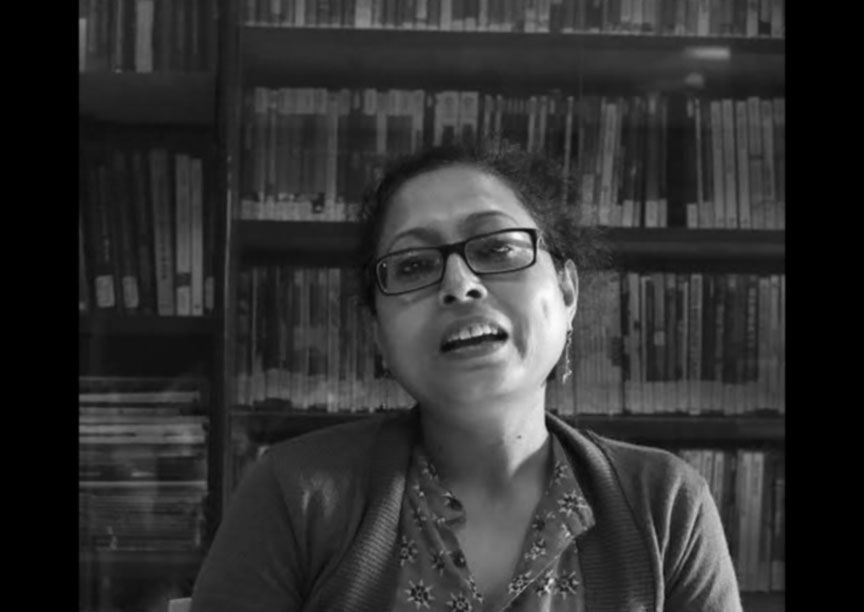
by Rongili Biswas
The Old Man at the Station
Of late, I would see him often. While going to the stazione, or coming back from another town. I did not know where he came from but one early autumn, he was there, a tattered overcoat and some torn clothes on him, sitting with some enormous rags underneath, at the back of the bus-shade, in the little space between the self-bar and the narrow pedestrian passageway. On the days our unfortunate grey town was allowed to catch a few rays—for, the town lay between two rivers Bormida and Tanaro, and forgetting that it was, after all, a river basin, seemed to grumble its lot by producing ashen vapours that hung perpetually in the air—he would nearly close his eyes, or blink every other second from where his two white eyeballs appeared and disappeared ere they could be seen by anyone else.
That day I was walking unmindfully back from the stazione after purchasing a ticket for Geneva, thinking about the change of trains in Milano, an act that I was never quite fond of. Then I saw a girl, rather tall, with a front-open far-lined jacket, going ahead of me, suddenly muttering to herself “mamma mia”. She came back a few steps from the tree-lined piazza nearby and looked at the old man. Only then did I notice that the man was dangling one of his feeble fingers towards her. In his other hand was a bread loaf – a whole one given him by some townsfolk as an act of charity. “Buon Dio”, the girl said again, and opened the bread loaf wrap for the man. Did the old man’s wrinkled weather-beaten face wear an expression? His hoary, cobweb eyes opening in a half-slit of gratitude? No, he was too debilitated. The girl did not even ask for it. How could she when it was a question of facing one of the most savage horrors around her as though in terrified disbelief?
I do not even remember if I stopped in my tracks to see whether the man could manage to take a bite off the loaf. What I remember is looking at the row of superb lush green trees in the piazza whose leaves rustled in the early Autumn breeze.
Between which the girl had disappeared wending her way down the road.
Early Morning Cuppa at Alessandria
The caffès would open at the break of dawn. If it was winter, it would be quite dark then and along via Ghilini — our treeless grey street that housed the infamous old-age home, an ancient school and residential houses, the school that claimed the minor distinction of having once educated Umberto Eco (but then, everything at our town contained that fame, since the poor man was born there, after all)—streetlights would still be on at that hour. The via, the school and especially the old-age home are sources of intriguing stories. But that I will talk about later. My landlady, Arianna would come at around 6—with Artù , the dog, and press my campanello (that is what the doorbell is so sonorously called in Italian). I would wake up with a start and try very hard to drive away the early morning sleep that so staunchly sat on my eyelids, Upon descending, we would walk towards the non-descript caffè which I doubt anyone ever visited during daytime. “Buon giorno, signore”, the owner would say, seeing us, the only coffee-seekers at that hour. “Un caffè maroccino, per favore”, I would say. Caffé Maroccino, a mixture of cocoa, frothy milk and coffee that smelled blissful, was the only one I always wanted to have there. Ari would go for her usual caffè normale, a super-strong coffee, which, as you can see, is considered normal in that part of the world. In the dimly-lit shop, still half- awake, I would ask the dog, “Artù, vuoi un caffè?‘ The young dog with shiny black hair would make some unprofitable sound of its breed, as if to say: yes, why not?
And the usually sombre shop-owner would laugh heartily at that.
Artù, the Beagle
Ginevra, a beautiful girl with a rather saturnine temperament was my landlord Maurizio and Arianna’s daughter. It was one late summer day, nearly dusk. L., my colleague and I had come over to their house, and Ari, one of the kindest women I have ever come across, offered us tea, breaking the custom of not offering hot beverages after sundown, for that is the time specifically kept for aperitivo in Italy. Of course, her kindness consists in other things than offering tea in the evening, but that, as the Italians say, is un altro discorso—another matter altogether.
As soon as Ginevra entered, Artù, their beagle, came running, wagging his tail. Ginevra smiled, a rare gesture from her, and pointing fingers toward the dog started shrieking “Che brutto il cane, bruttisimo”. That Ginevra was calling him an awfully ugly dog, which by all measures wasn’t true, did not seem to have much effect on Artù. He tried to lick Ginevra’s hand and got a little thrashing from Maurizio who told him to go and lie on the divan straightaway. Artù pulled a particularly long face, droll and tragic at the same time.
Ari took matters in hand:
“Now, now, don’t we go to puppy school for a week, Artù?”
In the half-minute it took us to wonder what a puppy school could possibly be, Artù, with Ari’s prompts, started showing his antics. There were many: going round and round in circles; moving forward and backward; doing otto, or imagining a big eight on the floor and running on its circumference. After a while, he became tired, ran to the divan to stick out his tongue, and started panting.
For a moment, in the coolness of the breeze, I thought I saw fireflies just outside Ari’s parlour windows, flickering over the funereal sky of our woebegone via Ghilini.
Except, there were no fireflies. Only a starless night had begun to descend.
The Huckster on Via Casale
The man stood before us—toothless. My colleague, Maurio and I were having an afternoon chat on via Casale—a nondescript street in our town—and sipping a particularly insipid variety of lemon tea—the al limone.
The man came with his wares. He had obviously crossed the Mediterranean but by his looks we could see that he was not from the northern tip of Africa, possibly somewhere from the centre or the far west of the continent. And, in accordance with the usual mafia-dealings in that region, was left in the lurch. After being brought over to Italy. Hidden in an inner hull of a ship, perhaps.
With sagging jaws, and an unhealthy yellowish tinge on his body, there was no way one could tell his age. He held out a cheap bracelet with vibrantly colourful beads.
Mauro waved him off, casting a disdainful look at his trinkets. But he stood still.
“Do you want any”? Mauro hastened to ask me to get rid of him. I cannot say even today what devil got into me that I vigorously shook my head and said, “No”, before he could even finish his question.
“Va”, Mauro asked the man. He was still standing there.
“Non voglio niente. Va, va, just go, we want nothing”. Mauro yelled at him.
I was mortified. So much so that I forgot to ask Mauro whether he couldn’t have been less rude with the man on whom his country’s mafia had played their usual tricks as they do with hungry people of many parts of the world.
By then, the man, abandoned in a ruthless grey town, thousands of miles away from his home, tottered with his unsold wares into the gathering dusk.
BIO

Rongili Biswas is a bilingual writer and musician from Kolkata who has lived in the UK, France, and Italy. She is the author of a novel and a collection of short stories and has edited three books. Her work—fiction, essays, and poetry—has appeared in journals and periodicals including The Telegraph, Danse Macabre, Setu, Ariel Chart, The Antonym, and Jadavpur Journal of Comparative Literature. Her novel Jahangir, Who Had Disappeared from Custody received the Bangla Academy Award (2015), and her story The Ballad of the Palm Trees won the Katha Award (2005). She was nominated at the Iceland Writers’ Retreat, 2023 Award and was an awardee of the Can Serrat Writers’ Residency, Spain in 2017. She has recently completed a novel on nineteenth-century France (forthcoming, 2026).